


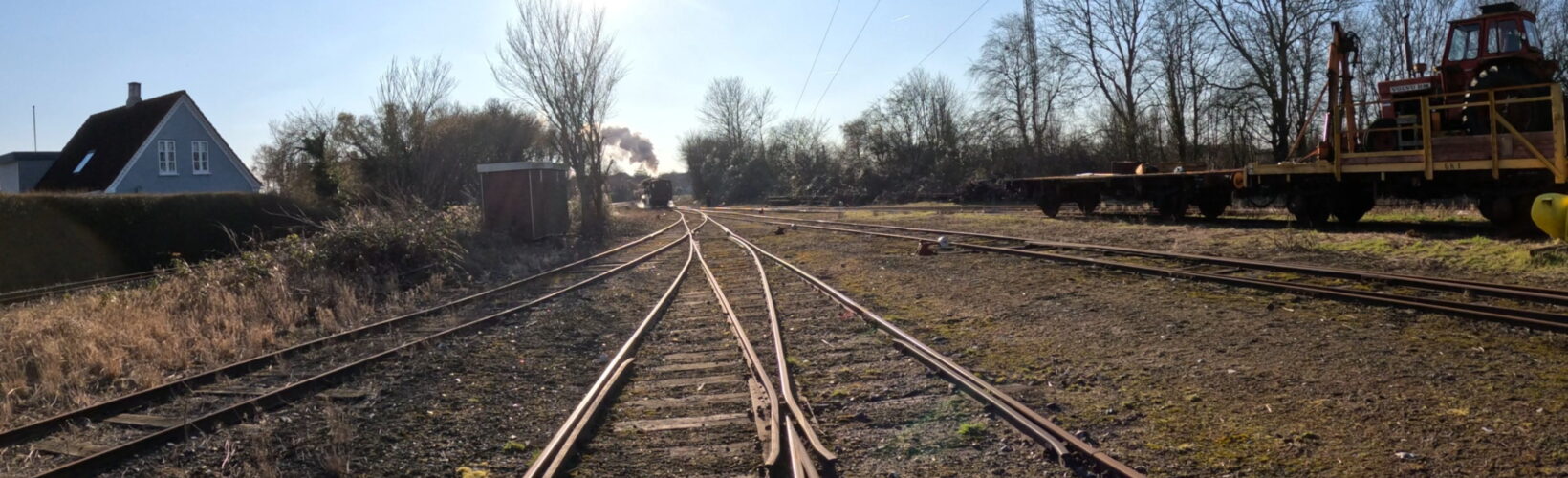
The track
History of the Maribo – Bandholm railway
Maribo is the only market town on Lolland without a port. In the middle of the last century, the town was the center of extensive agricultural trade, especially with grain, and thus there was a need for better transport options to the port of Bandholm.
Denmark's first private track
The railway between Maribo and Bandholm was inaugurated on November 2, 1869, with Knuthenborg Gods, which owns Bandholm Harbour, and Privatbanken as the main shareholders. It was Denmark's first private railway.
Available for operation were 2 steam locomotives, built by Robert Stephenson in Newcastle, 6 passenger cars and 10 freight cars, built in Randers. The route is 8 km long and built with standard gauge.
Bandholm station and its functions
Bandholm station was built for its opening in 1869. The main building was furnished with an office, waiting room, station restaurant, post and telegraph office, storage room and accommodation for the station manager, who was also the line's operations manager. The conditions were cramped.
Until 1879, tickets were sold on the trains, but after that the station sold tickets for both trains and certain ship routes. Bandholm harbor was a traffic hub for scheduled traffic with the islands of Askø, Fejø and Femø, as well as a port of call for ship routes between Copenhagen and western Baltic ports.
Port traffic and freight transport
Even greater importance was attached to freight traffic via the port, with grain, coal, lime and sugar. The sugar factories in Maribo and Holeby were important customers.
Gradually, Maribo – Bandholm Jernbane A/S was taken over by the Lolland-Falsterske Jernbane Selskab. In 1904, Bandholm station was staffed by 1 station manager, 1 assistant of 3rd class, 1 carriage master and 3 station attendants as well as 4 postmen.
Expansion during World War I
During World War I, traffic increased so much that new buildings had to be built. In 1919, the warehouse north of the main building was built, and at the same time, the villa immediately north of the warehouse was built as a service residence for the stationmaster.
Decline and transition
Until 1960, the Bandholm Line had a large freight traffic. On busy days, 2 locomotives were engaged in port marshalling and line running with 10-12 extra freight trains in addition to the normal timetable.
But since then things have gone downhill. Passenger traffic was partly replaced by regular buses, and in October 1952 the last passenger train ran. The station operated fully until June 1953. It was converted into a regular bus station with a kiosk in 1956.
Lolland Line continued to run freight wagons to Bandholm as needed until June 1999.
The origin and development of the Museum Railway
In 1962, “new” traffic came onto the line, as the Danish Railway Club received permission from Lolland Line to run a Museum Train between Maribo and Bandholm “on Sundays and public holidays, when there are no freight trains running”.
Since then, the Museum Line has expanded its operations somewhat, operating 50-60 days per year. The Museum Line officially became a veteran line in 2018, when Lokaltog transferred the management of the track to the association.
Conservation and new use
The main building at Bandholm station was listed in 1972, and the Danish Railway Club bought the entire station in 1984, including the warehouse.
During a major renovation in 1999, a toilet building was added, and a few years later – in 2012 – a special building for trolls was put into use.
Preserved elements from the original course
From the original Maribo - Bandholm Railway, there is today - in addition to Bandholm station - the passenger car A 1, which still runs on the track.
Literature
There is a wealth of literature about railways, including some about the Museum Railway. Interested parties can be referred to Railway Books.